

What it is:
AI job displacement refers to the growing impact of artificial intelligence automating or augmenting knowledge-based work such as data analysis, customer support, research, and software development.
Why it matters:
AI is no longer just affecting manual labor. Increasingly, white-collar and knowledge workers are seeing their roles reshaped as companies adopt AI tools to improve productivity and reduce operational costs.
What to consider:
Red flags:
Bottom line:
AI will likely create more jobs than it eliminates in the long run, but the transition will not be smooth. Organizations that combine AI adoption with thoughtful workforce planning and flexible hiring strategies will be best positioned to navigate the change.
We built a mental model of AI job displacement that was supposed to start somewhere familiar: factories, warehouses, and logistics hubs. For years, the dominant narrative looked like this:
It was a clean story. Predictable. Comfortable. And most importantly, it kept disruption at a safe distance from people with degrees, laptops, and white-collar titles. But the past few years have quietly rewritten that script. AI didn’t arrive first on the factory floor. It showed up in the corner office, the analytics dashboard, and the customer support queue.
Several enterprises made announcements that should have changed how every executive thinks about workforce strategy. Companies that were performing well, by most financial metrics, still reduced headcount while expanding their investments in AI.
Examples include:
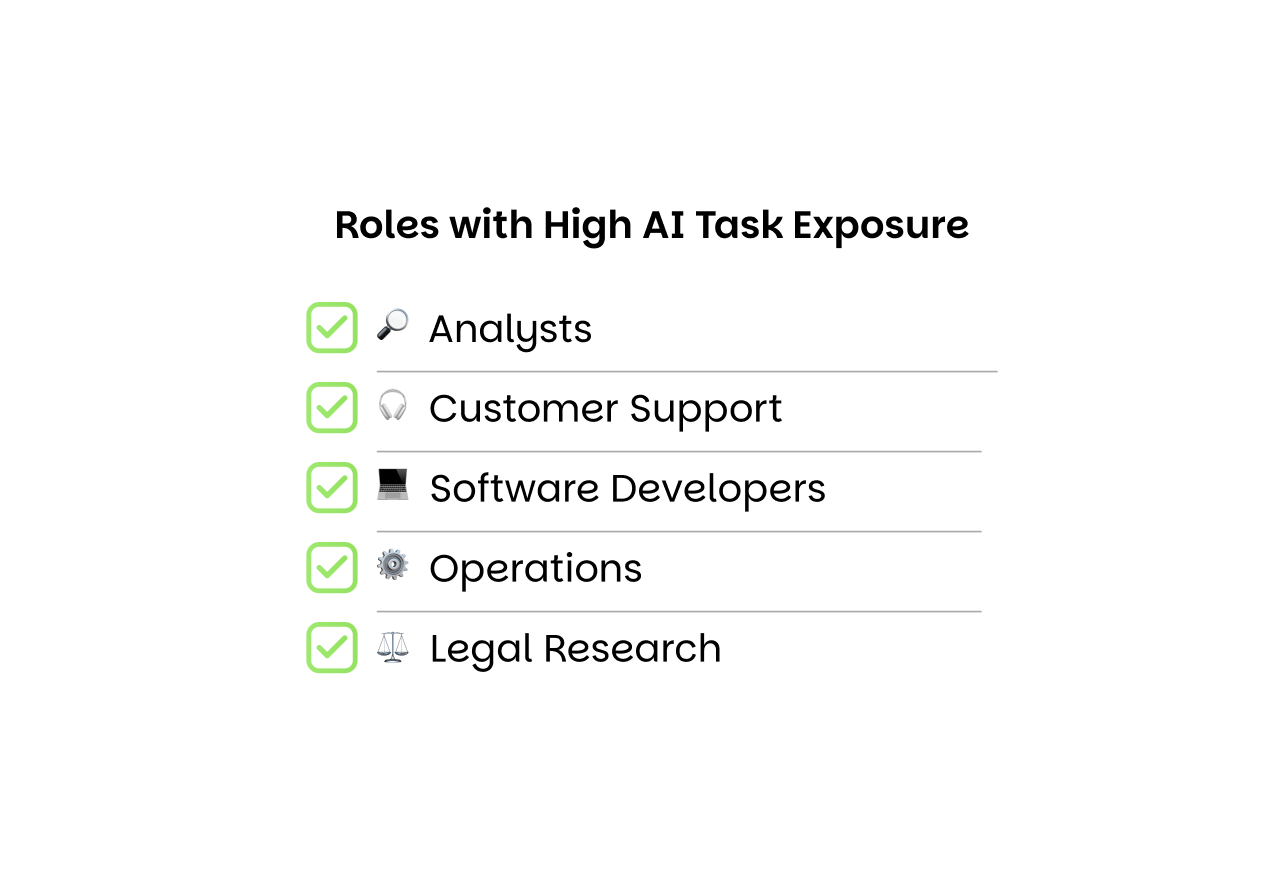
These weren’t struggling companies trying to survive. They were profitable organizations optimizing for an AI-augmented future. And the roles affected were not factory workers or warehouse operators. They were:
For years, these jobs were considered relatively safe. After all, they relied on human judgment, communication, and decision-making. But AI doesn’t respect those traditional boundaries.
Historically, automation targeted repetitive physical labor first. Machines were good at predictable tasks. Humans handled complex thinking. But generative AI has changed that equation. Research now shows that knowledge-intensive roles have some of the highest exposure to AI-driven task automation, particularly in areas such as:
These fields rely heavily on information processing, which modern AI systems can increasingly perform. The result isn’t always immediate job loss. More often, it’s job compression: One AI-augmented worker can suddenly do the work that previously required several people. And that shifts how companies design teams.
Need consultation on how to build your dream team? Hit us up!
According to the World Economic Forum’s Future of Jobs Report, the global labor market is heading toward a massive transition. The report projects that by 2030:
On paper, that’s a net gain of 78 million jobs. But aggregate optimism can hide a more uncomfortable reality. Technological transitions are rarely smooth. The real challenge isn’t whether jobs eventually appear. It’s the time gap between disruption and opportunity. During that gap:
And the human cost of that transition rarely shows up in optimistic projections.
Even if the long-term outlook is positive, the short term can be painful. When AI changes how work gets done, three things tend to happen:
That uncertainty spreads quickly through a workforce. The WEF “Reskilling Revolution” notes that labour markets are evolving faster than education and training systems can adapt, creating urgency for reskilling and upskilling.
Surveys show employee anxiety around AI and job loss has increased significantly over the past few years. And anxiety tends to arrive before layoffs do. For companies trying to scale globally or build distributed teams, this transition creates additional complexity.
Organizations are not only navigating AI adoption, they’re also managing new global talent strategies, remote teams, and evolving compliance requirements. This is where flexible workforce models, such as using an Employer of Record, are increasingly becoming part of the solution. An EOR allows companies to hire globally while managing compliance, payroll, and employment risk, helping organizations remain agile as workforce needs evolve.

Most organizations are currently asking the wrong question. They’re asking:
“How fast can we implement AI?”
But the more important question is:
“What happens to our workforce in the next 18–24 months?”
The companies that will navigate this shift successfully are not necessarily the fastest adopters. They are the ones that adopt intentionally. That means:
Many organizations are also rethinking where talent comes from, using global hiring models to access specialized skills. To understand this shift check out our blog on Offshore vs. In-House Recruitment. In an AI-accelerated economy, talent strategy is no longer just an HR issue. It’s a core business strategy.
It’s easy to frame AI as something happening to workers. But workers still have agency in how they respond. The professionals most likely to thrive in an AI-augmented economy are not the ones avoiding AI tools. They’re the ones learning to work alongside them effectively. The skills becoming more valuable include:
AI is extremely powerful at processing information. But it still struggles with context, accountability, and human nuance. Those capabilities are becoming the real competitive advantage.
The question is no longer whether AI will reshape the job market. That transformation is already underway. The real question is whether your organization and your career has a strategy for what comes next.
Companies that treat AI purely as a cost-reduction tool may gain short-term efficiency. But the organizations that pair AI adoption with thoughtful workforce strategy will build something much more valuable: A workforce that evolves with technology rather than being displaced by it. And in the long run, that may be the only sustainable advantage.
For many SMEs, building this kind of adaptable workforce requires room to explore and experiment but that experimentation can be expensive. Leveraging offshore talent can lower the cost of trying new AI-driven workflows, roles, and projects, allowing smaller companies to test, learn, and scale what works without overextending their core team.





.svg.png)