

What it is:
An employer of record in Pakistan is a legal entity that hires employees, manages payroll, ensures compliance with Pakistani labor laws and handles statutory benefits on your behalf.
Why it matters:
Pakistan offers world-class tech talent at 70-80% lower costs but hiring there requires navigating complex labor regulations, tax treaties and employment contracts. An EOR eliminates that complexity, letting you hire in weeks instead of months and scale without legal risk.
What drives the decision:
Cost arbitrage (senior developers at $1.5k-$2.5K/month vs $10K+ in the US), English proficiency, strong engineering talent from top universities, time zone overlap with the US East Coast and a booming remote work culture with 24/7 tech hubs and coworking spaces built specifically for teams working in Eastern time.
What to compare:
Total cost per employee (EOR fees + salary + benefits + admin), compliance coverage (labor law, tax filings, contracts), speed to hire, whether the EOR provides local HR support and how they handle amendments, terminations and cross-border payments.
Red flags:
EORs that won't disclose pricing upfront, vague compliance guarantees, hidden fees for contract changes or offboarding, lack of in-country presence or providers that treat Pakistan as a "low-priority" market and offer cookie-cutter solutions.
Bottom line:
Pakistan is one of the best-kept secrets in global talent markets. With the right EOR partner, you can build a high-performing team there in weeks, stay compliant and save significantly without sacrificing quality. The key is choosing an EOR that knows Pakistan talent market, not one that treats it as just another checkbox on a global coverage list.
You're a US-based startup or SME looking to scale your team without the overhead of international expansion? Hiring through an employer of record Pakistan might be one of the smartest moves you'll make this year.
Pakistan has quietly become a powerhouse for remote tech talent, offering a rare combination of high-quality engineers, English proficiency, cultural compatibility due to the exposure to Western markets and cost efficiency that we don’t need to talk about here.
But here's the catch: hiring internationally isn't as simple as posting a job on LinkedIn and sending a contract. Labor laws, tax compliance, payroll infrastructure and statutory benefits vary wildly by country.
That's where an employer of record (EOR) comes in. An EOR handles all the legal, HR and administrative load so you can hire compliantly in Pakistan without setting up a legal entity, navigating unfamiliar labor codes or spending months (and tens of thousands of dollars) on international expansion that gets you nowhere.
This guide walks you through everything you need to know about using a Pakistan employer of record in 2026: why Pakistan is attracting North American companies, how EORs work on the ground, what to watch out for and how to make your first hire the right way.
Let's address the elephant in the room: when North American companies think about offshore talent, they usually default to India, the Philippines or Eastern Europe. Pakistan rarely makes it to their consideration. But here's what's changed.
The talent is real. Pakistan produces over 75,000 IT graduates annually from top-tier universities like the National University of Sciences and Technology (NUST), Lahore University of Management Sciences (LUMS) and FAST. We're talking about engineers getting placed at Silicon Valley startups, have built products for Fortune 500 companies and compete globally in hackathons and open-source contributions.
English proficiency is high. Unlike some markets where language barriers create friction, Pakistan has a strong English-speaking workforce. English is the medium of instruction in universities and colleges and the default language in tech and business environments. Your team in Karachi or Lahore will communicate as clearly as your team in Denver or Boston.
Time zone overlap works. Pakistan Standard Time (PST) is 10 hours ahead of US Eastern Time and 13 hours ahead of Pacific Time. That means a team in Islamabad working 6 PM to 2 AM local time has a 4-6 hour overlap with the US East Coast. But working in the eastern time isn’t a problem? Let’s break that down too.
The work culture has evolved. This is the part most people miss. Pakistan's remote work ecosystem has exploded post-COVID. Islamabad, Karachi, Lahore and other cities are packed with 24/7 coworking spaces and tech hubs specifically designed for teams working in Eastern or Pacific time.
The cost arbitrage is significant. A senior full-stack developer with 5+ years of experience costs $1,500-$2,500/month in Pakistan. The same hire in the US? $10,000-$15,000/month, minimum. That's not a 20% savings. That's 70-80%. And we're not talking about cutting corners. You're getting the same quality at a fraction of the cost.
Let's look at a real scenario. A US-based fintech startup (we'll call them "FP") was scaling fast. They'd raised a Series A, had product-market fit and needed to build out their engineering, sales and marketing functions. The problem? Hiring in the US was brutal. Senior developers wanted $150K+ base salaries, equity and full benefits. BDRs with 2 years of experience were asking for $70K. The burn rate was unsustainable.
FP"s CEO had heard about Pakistan through a founder network but was hesitant. Security concerns, political instability, quality questions. All the usual objections. But the numbers were too compelling to ignore. They decided to test the waters with one hire: a senior full-stack developer.
The Hire: They partnered with East Consulting, an EOR based in Boston and a headquarter in Islamabad with deep roots in Pakistan's tech ecosystem. Within a week, they had a shortlist of five candidates. All had 5+ years of experience. All had worked with US or European companies. All spoke fluent English. FP hired a developer for $1,800/month. In the US, the equivalent hire would've cost $10,000/month minimum.
The Outcome: The developer wasn't just "good for the price." He was excellent, period. Clean code, proactive communication and a work ethic that impressed the entire team. Within three months, FP expanded. They hired two more developers, a digital marketer, a BDR and an AI/ML engineer. Then another three engineers. By month six, they had a 12-person team in Pakistan across engineering, sales and marketing.
The Real Win: It wasn't just cost savings (though they saved over $800K annually compared to US hires). It was quality and stability. The team in Pakistan stayed. Zero turnover in the first year. Their core team in the US stayed and directed their offshore half. FP's Pakistan team became the backbone of their product development and go-to-market strategy.
The CEO's takeaway? "We came for the cost savings. We stayed because the talent is world-class and the team is more stable than anything we've built in the US."
Here's the reality: hiring someone in Pakistan as a US company isn't as simple as sending a contract and paying them via PayPal. Pakistani labor law requires a local entity to be the legal employer. You need to handle payroll in Pakistani Rupees, withhold income tax, contribute to the Employees' Old-Age Benefits Institution (EOBI), manage social security, and comply with termination notice periods and severance requirements.
Setting up a subsidiary in Pakistan to do all that? You're looking at 4-6 months, thousands of dollars in legal and administrative costs and ongoing compliance headaches. For most startups and SMEs, that's a non-starter.
That's where an EOR comes in. An EOR in Pakistan is a local legal entity that hires your employee on your behalf. They become the employer of record for legal and tax purposes, while you retain full control over the employee's day-to-day work, performance and responsibilities.
For a deeper dive into how an EOR works, check out our guide on What is an EOR?.
If you're considering Pakistan, you're probably also looking at India and Bangladesh. Here's how they stack up.
Pakistan vs India: India is the default choice for most US companies and for good reason. The talent pool is massive, the ecosystem is mature and English proficiency is high. But the market is over-saturated. Competition for top talent is fierce, which drives up costs. Attrition rates are high because every recruiter and startup is fighting for the same talent. Pakistan offers comparable quality at 30-40% lower cost with significantly better retention.
Pakistan vs Philippines: The Philippines is favored by US companies for strong English proficiency, cultural alignment and time zone overlap enabling real-time collaboration. Pakistan offers lower costs and a younger tech-savvy workforce making it ideal for cost-efficient high-quality teams.
Pakistan vs Bangladesh: Bangladesh has a strong and growing BPO sector, particularly in call centers and customer support, with competitive pricing even lower than Pakistan's. However, when it comes to senior engineering talent, Pakistan has a more established tech ecosystem.
Pakistan's Edge: The combination of cost, quality, English proficiency, time zone overlap and evolving work culture makes Pakistan the sweet spot for North American SMEs. You're not sacrificing quality for cost. You're getting both.
Pakistan’s labor laws provide a framework of statutory benefits and protections designed to safeguard employee rights and ensure fair treatment across industries. These entitlements cover working hours, paid leave, social security, retirement benefits and workplace protections that employers must uphold.
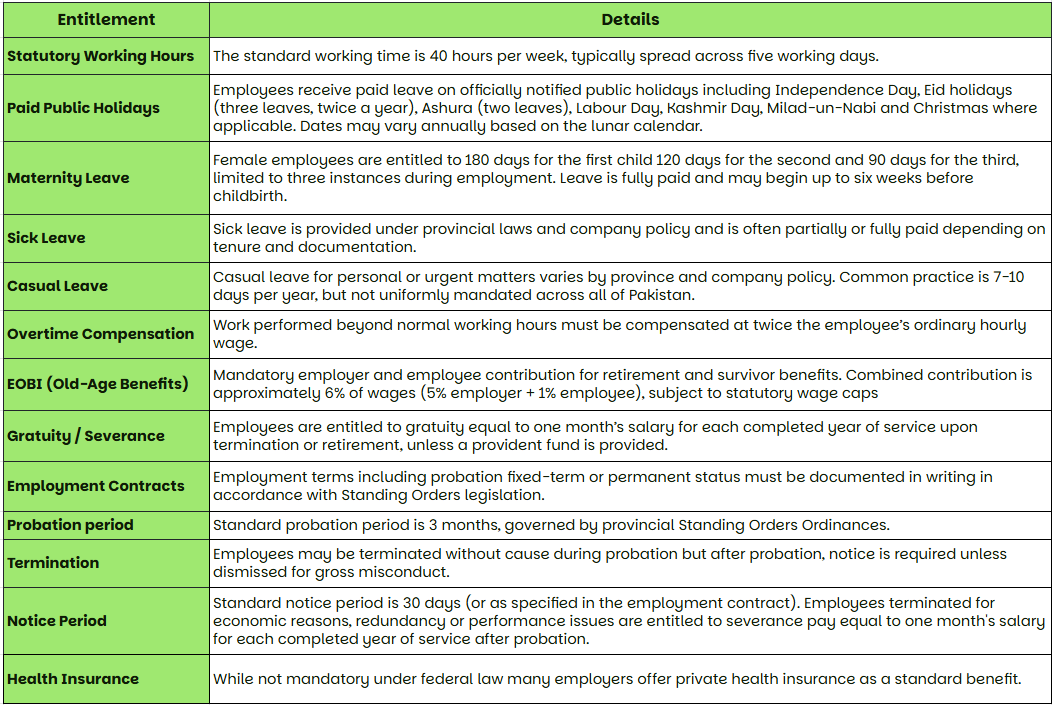
Let's tackle the concerns head-on because if you're reading this, you've probably heard them.
"Isn't Pakistan politically unstable?" Pakistan has its challenges, but the tech hubs in major cities operate independently of broader political dynamics. The remote work ecosystem is insulated, professional and globally connected. Companies like Careem, Daraz and dozens of Y Combinator-backed startups have built teams there without issue. The key is working with a reliable partner that has on-the-ground presence and can navigate local dynamics.
"What about security and data protection?" This is a fair question. Pakistan doesn't have GDPR-equivalent data protection laws, so if you're handling sensitive customer data, you'll need to implement your own security protocols (VPNs, encrypted communications, access controls). But here's the reality: the same is true for most markets outside the EU. The solution isn't to avoid Pakistan. It's to work with a reputable EOR, vet candidates carefully and use the same security best practices you'd use for any remote team.
"Can Pakistani workers really work in US time zones?" Absolutely. This is where the culture shift matters. Pakistan's tech workforce has fully embraced remote work in Western time zones. Coworking spaces in Islamabad and Karachi are open 24/7. Developers, designers and BDRs routinely work 6 PM to 2 AM local time to overlap with US East Coast hours. It's not a sacrifice. It's the norm. The infrastructure, community and culture are all built around it.
"What about H-1B visas and travel?" If you ever need your Pakistani employee to visit the US for onboarding, team meetings or client visits, they'll need a B-1 business visa. The recent H-1B policy changes under the current administration have made it harder to sponsor work visas for international hires, which is another reason why EOR models are gaining traction. You get the talent without the visa headaches. For more on how H-1B changes are reshaping hiring strategies, read our blog on H-1B visa updates.
Here's how the process works when you use an employer of record Pakistan provider like East Consulting.
Step 1: Define the Role and Salary Range. Be clear about what you need. Developer? Designer? BDR? Marketing lead? The more specific you are, the faster the process. Salary ranges in Pakistan for common roles: Junior developer ($650-$1K/month), Mid-level developer ($1K-$2K/month), Senior developer ($2K-$3K/month), BDR/Sales ($800-$1K/month), Digital marketer ($1K-$2K/month), AI/ML engineer ($1K-$2K/month).
Step 2: Partner with an EOR. Choose an EOR with local presence in Pakistan, transparent pricing and experience hiring for your industry. Avoid providers that treat Pakistan as a checkbox on a global coverage list. You want someone who knows the market inside out.
Step 3: Source and Interview Candidates. Whether you source the candidates or an EOR does that for you. Either way, the interview process is no different than hiring locally. Video calls, technical assessments, reference checks.
Step 4: Extend an Offer. Once you've selected a candidate, your EOR drafts a compliant employment contract under Pakistani law. This includes salary, benefits, notice periods, termination clauses and any company-specific policies. The contract is between the EOR and the employee, but you approve all terms.
Here's the link for the complete official document for tax rates in Pakistan.

Step 5: Onboarding. The EOR handles all onboarding paperwork: tax forms, bank account setup, EOBI registration, health insurance enrollment. Your employee starts on day one fully compliant and ready to work. You handle the functional onboarding (tools, access, training) just like any other hire.
Step 6: Ongoing Management. You manage the employee's work, performance and deliverables. The EOR handles payroll, tax filings, benefits administration and compliance. If you need to change compensation, update the contract or offboard the employee, the EOR manages the legal and administrative process.
For more on what EOR services include, see our services.
1. Speed to Hire: Setting up a subsidiary takes 4-6 months. With an EOR, you can hire in 2-3 weeks. That's the difference between missing a product deadline and launching on time.
2. Cost Savings Without Compromising Quality: You save 70-80% on salary costs compared to US hires, but you're not hiring "budget" talent. You're hiring world-class engineers, designers and marketers who happen to live in a lower-cost market.
3. Full Compliance, Zero Risk: Understanding labor laws is a complex task. Termination requires 30-90 days' notice depending on tenure. Severance is mandatory. Tax filings are monthly. An EOR handles all of it. You don't need to become an expert in employment law. Your EOR already is.
4. Access to a Growing Talent Pool: Pakistan's tech ecosystem is booming. Over 300,000 people work in IT and IT-enabled services. The government is investing heavily in tech education and digital infrastructure. You're tapping into a market that's on the rise, not one that's plateaued.
5. Time Zone Overlap: Pakistan’s time zone is not a barrier for working with global teams and supports smooth communication, live collaboration and consistent team alignment without relying heavily on asynchronous handoffs.
6. Stability and Retention: Turnover in Pakistan's remote workforce is significantly lower than in the US or even India. Employees value the flexibility, compensation and career growth opportunities that come with working for international companies. Once you hire a great team in Pakistan, they tend to stay.
7. Scalability: You can start with one hire and scale to 10, 20, or 50+ without the overhead of managing a local entity. Your EOR partner handles all the administrative complexity, whether you have 1 employee or 100.
Not all EORs are created equal. Here's what to watch out for.
For a detailed breakdown of what should be included in an employer of record agreement, read our blog on EOR Agreement: Everything you need to know.
We've spent years building deep expertise in Pakistan's talent market. We're not a global platform that treats Pakistan as just another country on a list. We're headquartered here. We know the universities, the coworking spaces, the labor laws and the talent pipeline better than anyone.
We've helped dozens of North American SMEs build teams in Pakistan across engineering, sales, marketing, customer success and much more. Our clients stay with us because we deliver on three things: quality talent, full compliance and transparent pricing. No hidden fees. No surprises. Just great hires who stick around and help you grow.
If you're ready to explore hiring in Pakistan, let's talk. We'll walk you through the process, answer your questions and help you make your first hire the right way.
If you're a US-based startup or SME looking to scale your team, cut costs, and access world-class talent, Pakistan should be on your shortlist. The combination of cost efficiency, quality, English proficiency, time zone overlap, and a thriving remote work culture makes it one of the best-kept secrets in global hiring.
The challenge isn't whether the talent is there. It is. The challenge is hiring compliantly, managing payroll and benefits, and navigating unfamiliar labor laws. That's where an employer of record Pakistan partner makes all the difference.
With the right EOR, you can hire in weeks, stay fully compliant, and build a team that sticks around and delivers results. The question isn't whether Pakistan is worth exploring. It's whether you're ready to get ahead of the curve before everyone else figures it out.






.svg.png)