

An Employer of Record (EOR) is a service that lets you hire legal employees in other countries without setting up a local company or using risky contractor agreements.
How it works:
Why use one:
Who needs it:
EOR vs PEO:
Bottom line: If you want to hire great talent globally without legal nightmares or huge setup costs, an EOR is your answer.
Have you wondered why global hiring is growing and why companies are turning to offshore talent? Probably, yes. That's why you're here. And once you dig into the topic, another question naturally comes up: what is an Employer of Record? We'll get into that in a moment.
The talent market is becoming borderless. In this infinite realm, finding great offshore talent is hard. Keeping them compliant, legally employed and happy? Even harder.
That's where an Employer of Record (EOR) comes in. In this guide, we'll cover everything you need to know about EORs, what they are, how they work and why they might be exactly what your business needs. Let’s get into it.
An Employer of Record (EOR) is a service that lets you hire legal employees in other countries without setting up a local entity or relying on contractor agreements.
Here's the scenario: You're a founder of a small team. You want to hire someone offshore. You find the perfect candidate on LinkedIn, conduct interviews and they're ready to start.
But then reality hits.
To legally employ someone in another country, you need to either:
Both options are a mess for different reasons. We'll get into these risks later.
An EOR solves this by acting as the legal employer on paper, while you retain full control over the employee's day-to-day work.
Here's how it works:
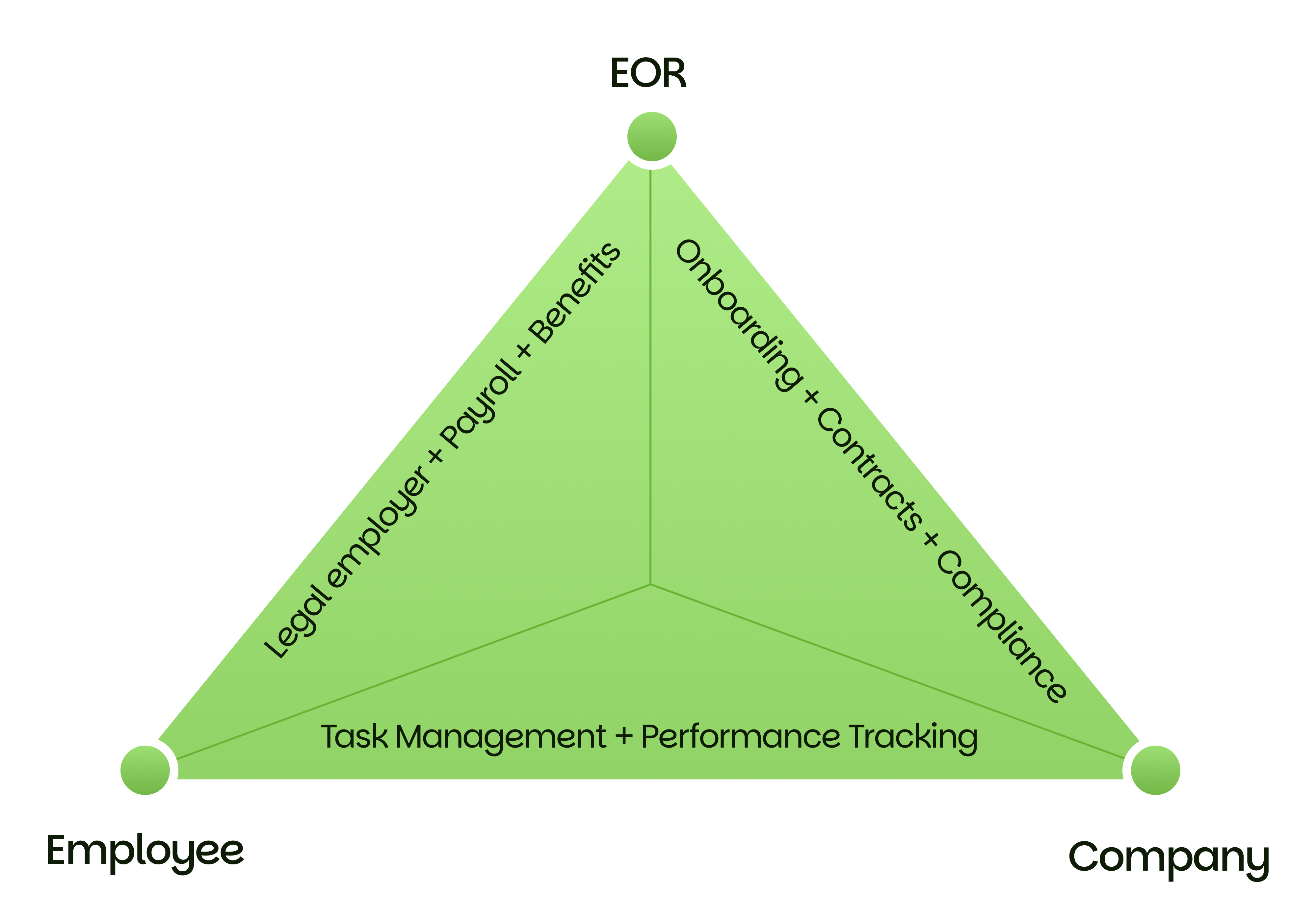
The legal setup plays out like this: you sign a contract with the EOR and the EOR signs a contract with the employee, simple chain. And yes, the contract has to spell it out clearly, the EOR is the legal employer acting on your behalf, you’re the one pulling the strings, they’re the one holding the paperwork.
Think of it like this: The EOR is the legal umbrella. You're the boss. The employee does the work. Everyone stays compliant.
Contractors are independent workers. They invoice you. They handle their own taxes. They're not legally your employees.
Sounds simple, but it's risky:
An EOR gives you real employees, legally compliant, with benefits and more committed to your company.
It depends on your goals.
If you're planning to establish a long-term physical presence in that country, open offices, build infrastructure, hire locally at scale, then yes, setting up a legal entity makes sense.
But for most companies hiring a small team of employees internationally? It's not the most efficient path. Here's why:
An EOR isn't about cutting corners. It's about choosing the right tool for the stage you're at.
EORs aren't for everyone. But if you're in one of these categories, they're probably a great fit:
You see the value in geographic diversification and not putting all your hiring eggs in one regulatory basket.
You need senior talent but can't afford US salaries or the time and cost to set up entities abroad.
You want to hire offshore but don't have the bandwidth to deal with compliance, payroll and HR.
Your team is already distributed. An EOR makes it easy to hire anywhere without legal headaches.
If any of these sound like you, an EOR is worth exploring.
Let's break down the process step-by-step.
Why are companies choosing EORs over setting up local entities or hiring contractors? Here's why:
Setting up a legal entity can take months and cost tens of thousands of dollars. According to a survey, it costs more than USD 10k to hire for roles in high-demand fields (Engagedly, 2025). An EOR lets you hire in just a couple of weeks, sometimes days, that too while staying on a budget.
Employment laws vary wildly by country. An EOR ensures you're compliant with contracts, taxes, benefits and labor regulations. No surprises. No penalties.
Payroll, taxes, benefits, HR paperwork, it's all handled. You focus on running your business, not navigating foreign bureaucracy.
Unlike contractor agreements, an EOR gives employees real employment status. That means benefits, stability and retention. Employees stick around when they're treated like employees, not gig workers.
EORs eliminate the need for setting up local entities and the associated costs (Remundo, 2024). With an EOR, you know what you're paying for. No hidden legal fees, no surprise compliance costs. Just a clear monthly rate per employee.
A Philly-based SaaS startup was burning cash trying to hire senior engineers in the US. They switched to an EOR, built a team in South Asia and cut hiring costs by 70%. They're not just surviving now, they're scaling, with a stable team that's been with them for over an year.
Nobody’s perfect, so do EORs. Here are some things to watch out for, so you choose the right EOR:
Some EOR providers advertise low fees but tack on extra charges for benefits, onboarding or compliance updates. Ask for a full breakdown. What's included? What costs extra? No surprises.
Make sure the EOR operates in the countries you're hiring from and has deep compliance knowledge there.
Can they handle local benefits, taxes and currency conversions smoothly? Check reviews and ask for references.
When issues arise (and they will), you need responsive support. Test their communication before committing.
Some EORs lock you into long-term contracts. Look for flexibility, especially if you're testing a new market.
A good EOR will be upfront about costs, proactive about compliance and easy to work with.
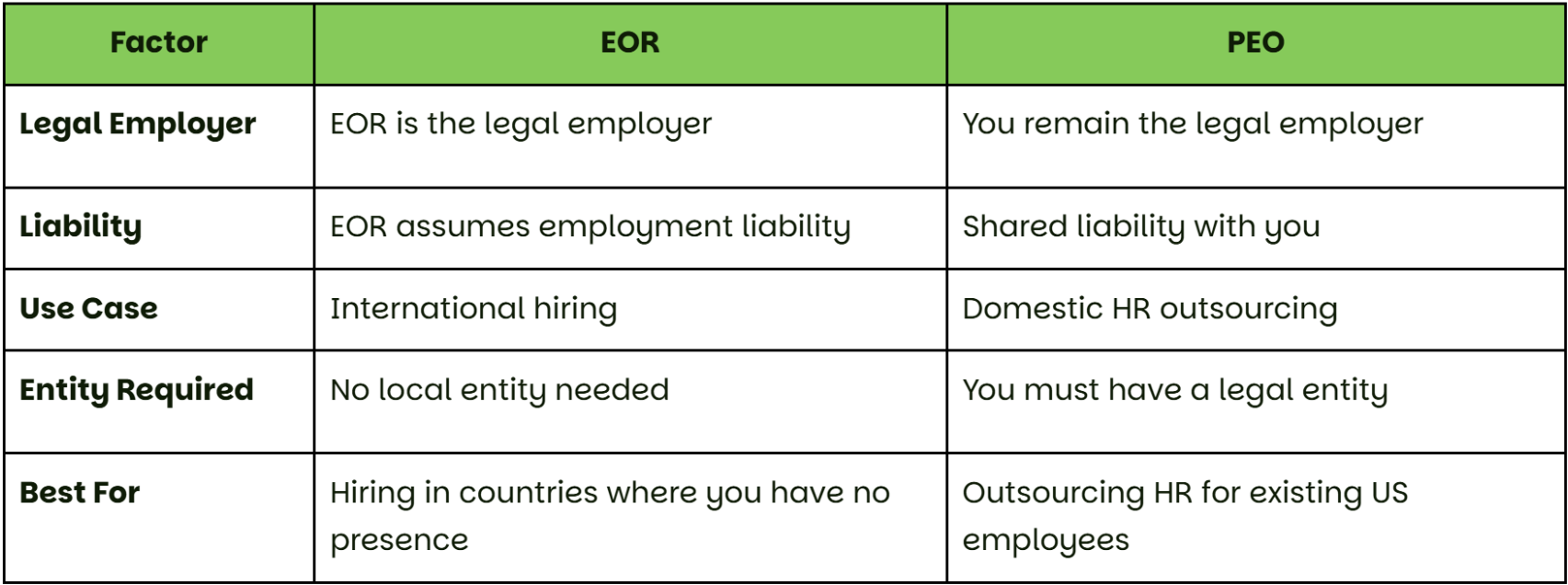
People often confuse EORs with PEOs (Professional Employer Organizations). They're similar but not the same.
Hiring offshore doesn't have to be complicated but it can be if you don’t have the right structure in place. An Employer of Record (EOR) simplifies global hiring by acting as the legal employer for your international employees while you maintain full control over their work. This arrangement allows you to scale your team quickly, access top talent in new markets and stay compliant with local labor laws, all without the headache and expense of setting up local entities.
Whether you’re a startup scaling fast, a remote-first company expanding globally or a solopreneur hiring a few key people offshore, a well-chosen EOR can be the difference between struggling with global compliance and thriving with a seamless, scalable international team.
At East Consulting, we help North American companies build offshore teams in South Asia without the legal headaches. We handle the compliance, payroll, benefits and HR side, so you can focus on managing the work, not navigating foreign labor law. We vet for culture fit and technical skills, because hiring globally shouldn't mean compromising on quality or dealing with constant turnover.
Hiring globally shouldn’t mean sacrificing quality, efficiency or control and with the right EOR, it doesn’t have to. If you're exploring offshore hiring and want to understand how an EOR actually works in practice, we're here to help.
Here's another resource to help you make an informed decision.






.svg.png)