

What it is:
Why it matters:
What drives the cost:
What to compare:
Red flags:
Bottom line:
Transparent pricing tells you the truth, hidden pricing tells you a story. Always calculate the full annual cost per employee, compare models side by side and avoid any provider that won’t disclose fees upfront.
Employer of Record (EOR) pricing can feel like a black box. Some providers advertise low monthly rates but hit you with surprise fees later. Others use percentage-based models that scale unpredictably as salaries increase. And most won't tell you the real cost until you're deep into a sales call.
If you're evaluating EOR services, understanding pricing isn't optional. It determines whether you're getting a fair deal or paying for things you didn't know were extra.
Let’s break down how EOR pricing works, what affects it, the hidden costs to watch for and how to compare providers without getting burned.
Employer of record pricing is what you pay an EOR provider to legally employ workers in other countries on your behalf.
The price typically covers:
But here's where it gets messy: Not all EOR pricing models are the same. Some charge flat rates. Others charge a percentage of payroll. Some bundle everything. Others nickel-and-dime you with add-ons.
Understanding the model is the only way to know what you're actually paying for.
Employer of Record services pricing isn't one-size-fits-all. Several factors influence what you'll pay:
Employment laws, tax structures and benefits requirements vary wildly by country. Hiring in Pakistan is cheaper than hiring in the US because compliance is less complex and benefits costs are lower.
Some EORs charge the same rate globally. Others adjust pricing by region. Always ask: "Does your pricing vary by country?"
If the EOR charges a percentage of payroll, a senior engineer earning $120K costs more to manage than a junior associate earning $40K, even though the administrative work is the same.
Flat-rate models avoid this problem. You pay the same monthly fee regardless of salary.
Are health insurance, pension contributions and paid leave included in the monthly rate? Or are they billed separately?
This is where "affordable" EOR pricing can balloon. A $299/month rate sounds great, until you realize benefits add another $300/month per employee.
Some EORs offer tiered pricing. The more employees you have, the lower the per-employee rate. If you're scaling fast, tiered pricing can save you money. If you're hiring one or two people, it won't help.
Regulated industries (finance, healthcare) often require additional compliance work. Some EORs charge extra for this. Others build it into their base rate.
Here’s the most common employer of record pricing comparison:
You pay a fixed monthly fee per employee. Simple. Predictable.
Example: $500/month per employee, regardless of salary.
Pros:
Cons:
Typical range: $199-$699/month per employee.
You pay a percentage of the employee's gross monthly salary.
Example: 10% of payroll. If the employee earns $5,000/month, you pay $500/month in EOR fees.
Pros:
Cons:
Typical range: 8-15% of gross payroll.
Some EORs charge a one-time setup fee to onboard the employee, then a recurring monthly flat rate.
Example: $800 setup fee + $500/month ongoing.
Pros:
Cons:
Typical setup fees: $500-$1,500 based on the service or complexity of the situation.
Note: Not all EORs charge setup fees. Some build onboarding into the monthly rate.
All-inclusive: One price covers payroll, compliance, benefits and HR support.
À la carte: Base rate for payroll and compliance. Benefits, contract amendments and termination support cost extra.
Example:

Here's where EOR pricing gets sneaky. Always ask about these before signing:
Some EORs charge $500-$1,500 per employee just to get started. This covers contract drafting, compliance setup and system onboarding.
What to ask: "Is there a setup fee? Is it one-time or recurring?"
Health insurance, pension, paid leave, these aren't always included in the base rate. Some EORs charge separately for benefits and costs vary by country.
What to ask: "Are benefits included in your monthly rate or billed separately?"
Need to change the employee's salary, title or work location? Some EORs charge $50-$200 per amendment.
What to ask: "Do you charge for contract amendments? How much?"
Ending employment can trigger severance obligations, notice period costs and offboarding fees. Some EORs pass these directly to you. Others build them into the monthly rate.
What to ask: "What happens if we terminate an employee? Are there additional fees?"
If you're paying employees in a currency different from yours, conversion and bank fees can add 1-3% to every transaction.
What to ask: "Do you charge currency conversion fees? What's the rate?"
Some countries require additional compliance work, extra tax filings, labor audits or regulatory reporting. A few EORs charge extra for "complex" countries.
What to ask: "Does your pricing vary by country? Are there additional compliance fees?"
Some EORs charge yearly "platform fees" or "account maintenance fees" on top of the per-employee rate.
What to ask: "Are there any annual or recurring fees beyond the monthly rate?"
Comparing EOR providers is tricky because pricing structures vary so much. Here's how to do it right:
Don't just look at the advertised rate. Calculate the all-in cost:
Base rate + Benefits + Setup fees + Amendment fees + Termination costs = Total cost per employee
Example:
Provider A (All-Inclusive):
Provider B (À La Carte):
Provider B looks cheaper upfront but ends up costing almost as much and you'll pay more if you need amendments or have turnover.
Run hypothetical situations to uncover hidden fees:
Make sure you're comparing the same services:
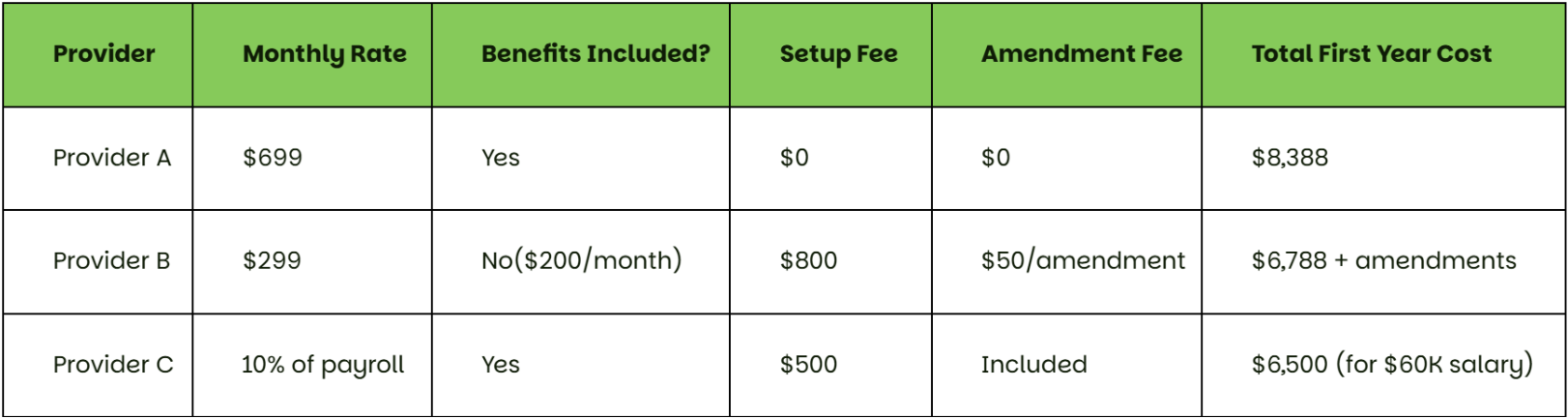
Now you can actually compare.
Pricing pages lie. Contracts don't.
Look for:
If the contract contradicts the sales pitch, walk away.
So what should you expect to pay?
These are bare-bones services. You get payroll and basic compliance. Benefits are usually extra. Support is limited.
Best for: Single hires, a lean startup aiming to scale fast.
Most established providers fall here. Benefits may or may not be included. Compliance is solid. Support is responsive.
Best for: Multiple hires, companies that want hands-off management.
All-inclusive. White-glove service. Benefits, compliance, HR support and sometimes even recruiting.
Best for: Enterprises, regulated industries, companies hiring in complex countries.
Watch out for these warning signs:
If they won't give you even a ballpark range upfront, they're probably overcharging or hiding fees.
"$99/month per employee!" sounds amazing, until you realize benefits, setup and compliance "enhancements" bring the real cost to $600/month.
If the pricing page just says "$500/month" with no details, assume everything important costs extra.
"Additional fees may apply based on country and compliance requirements" = surprise fees you won't know about until you're locked in.
EOR pricing shouldn't be a mystery. But too many providers make it one, hiding fees, using confusing models and burying costs in contracts.
Here's what to remember:
If you're evaluating EOR providers, don't just compare the advertised rate. Compare the total cost per employee over 12 months, including every possible fee. The 30 minutes you spend doing this math now could save you thousands later.
East Consulting uses flat-rate pricing for EOR services in South Asia. We charge a fixed monthly fee per employee that covers payroll processing, compliance, employment contracts and HR support.
We don't charge setup fees or contract amendment fees. What's included in the monthly rate stays consistent. Our pricing is disclosed upfront with a breakdown of what's covered and what's not, so companies know their total cost per employee before they commit.
New to EORs? Check out our guide: What is an Employer of Record?
Already working with an EOR? Learn what to look for in your agreement: Employer of Record Agreements





.svg.png)